
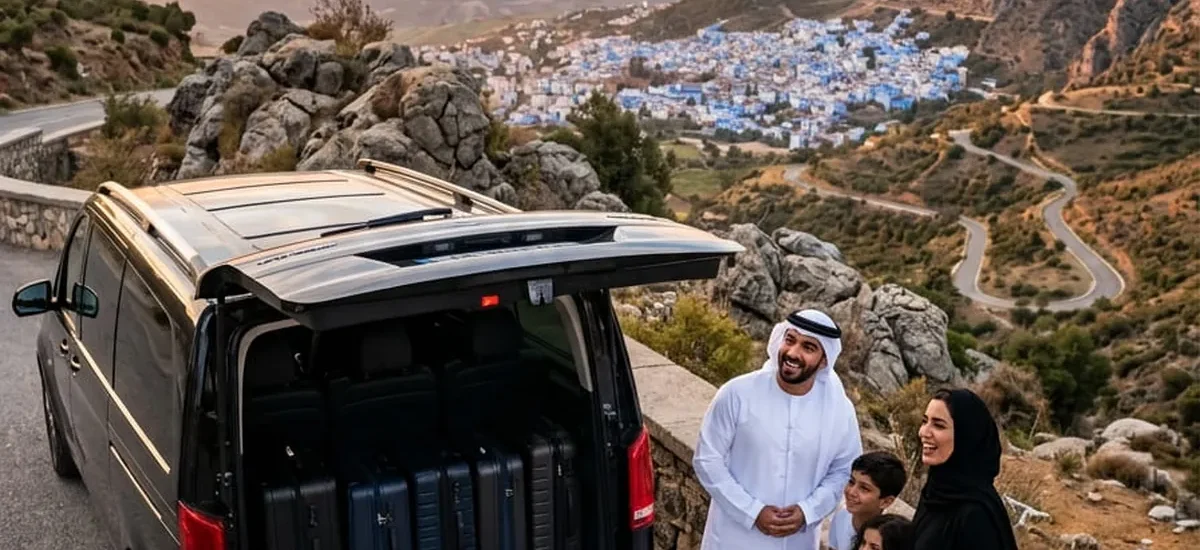
Imperial cities family itinerary: the complete Rabat-Chefchaouen-Fès route without logistics stress, with a private van
Rabat, Chefchaouen, Fès. Three stops that many families staying in Morocco want to cover in one imperial cities family itinerary. The capital sets the Andalusian scene, with its ramparts, its kasbah facing the ocean and its river. Chefchaouen then climbs into the Rif, with its blue-painted medina and its stepped alleyways. Fès closes the route to the east, behind the walls of its imperial city.
The project soon hits a concrete question. How do you move from one city to the next with children, suitcases and timetables to keep? The train exists. So does the bus, as do the rental car and the grand taxi. Each option answers part of the problem, then adds its own logistics.
This guide therefore compares two ways of covering the same route. On one side, shared public transport. On the other, a private van with a driver. The stages, the real constraints and the packages published by Booking Taxi Maroc are detailed below, without jargon.
Booking a private driver stays more comfortable than the train for an imperial cities family itinerary between Rabat, Chefchaouen and Fès, especially with young children or bulky luggage. The rail network serves Rabat, Fès and Tangier. No line reaches Chefchaouen. You therefore have to combine train and road from Tangier or from Fès, with changes to handle at every stage. The private van links the three cities door to door. It stops when the family decides and keeps the suitcases on board during the visits. Booking Taxi Maroc excursions are advertised at 2500 Dh par groupe to Chefchaouen and at 2500 Dh par groupe to Fès, fuel and tolls included.
Why this route gets complicated with a family
A solo traveller absorbs an extra connection without effort. With a three-year-old, a pushchair and two suitcases, the same connection turns into a house move.
First, every change of transport means getting the bags out. Then you have to find a platform or a stop, and negotiate a vehicle on the spot.
Repeat the operation over three journeys, and the sightseeing day shrinks to its useful portion. The accumulation weighs more than each stage taken separately.
Taken together, these details change a day.
The season matters too. Midday heat tires children faster than adults. Breaks to drink, sit down or move into the shade stop being a luxury. They become a planning necessity, to be built into a day already heavy with kilometres. Moroccan heritage also imposes a walking pace, because the medinas of Fès and Chefchaouen are covered on foot, over uneven cobbles and sloping alleys. A successful day therefore plans recovery time between two walks.
Imperial cities family itinerary: what the train and the bus really allow
The Moroccan train remains reliable transport on the main axes. Al Boraq brings Tangier within reach of Rabat, and the classic lines link the capital to Fès and Meknès. On paper, these connections cover two of the three stages of the route.
The third city stays outside the network.
Chefchaouen, the link with no station
Chefchaouen has no railway station. Travellers arriving by train go through Tangier or through Fès. The last segment is then covered by bus or by grand taxi. That segment requires a new booking, a new timetable and fresh handling of the luggage. For a family, it mostly consumes time and energy.
Nothing is impossible, of course, since families make this trip every week.
On the other hand, tiredness builds up fast.
The point of vigilance lies in the accumulation: train, connection, road, then a walk in the medina on the same day.
Fixed timetables and suitcases
The train imposes its departures. A family that wants to visit a medina at its own pace keeps little room for manoeuvre, because the return depends on a fixed hour. Buses serve more localities, with more flexible frequencies. However, side-by-side seats are never guaranteed and the stops multiply along the route.
Renting a car removes the timetable constraint. The problem then moves elsewhere. Driving on mountain roads demands attention, parking near the medinas becomes difficult and the old centres multiply the one-way streets. Add the fatigue of the driver, who stays the same all week. On top of that come a deposit to block, a full tank to return and a contract to read before departure. These three formalities occupy the mind at the very moment when the family simply wants to set off. Driving at night on the Rif roads then requires constant vigilance. The return journey also falls at the hour when the children are already tired.
What a private van with a driver changes day to day
In practice, the private van moves the starting point. The door of the accommodation becomes the first marker of the day. In the evening, the same address welcomes the family back. In between, the programme belongs to the passengers.
The rest comes down to the vehicle and the driver.
Free stops and a pace you choose
A panorama over the Rif, a break on a shaded service area, a photo from a belvedere: these decisions are taken on the road. The local driver knows the viewpoints along the route. He also knows at which hours the light falls best on the hills.
Flexibility counts double with children, because an unplanned break costs neither a ticket nor a wait at a station.
Family safety and luggage handling
Children stay in a vehicle driven by a professional of the road. They avoid connections and changes of driver. The suitcases travel on board, then wait for the group during the visits. That detail removes the carrying between two stations, often the most thankless part of the journey.
Booking Taxi Maroc advertises a spacious, air-conditioned Mercedes-Benz Vito or V-Class van. The space available changes the comfort of a day spent between the road and the medinas a great deal.
In the evening, the return journey is made in the same vehicle.
Logistics therefore come down to a single question: the departure time.
The three stages of the route, in order
To start with, each city is visited over a full day from Rabat. The sequence starts in the capital, climbs to the Rif, then heads for the east of the country.
Rabat, the logical starting point
The capital concentrates the accommodation, the stations and the motorway access. A half-day guided tour of the city sets the historical context of the stay. The Kasbah of the Udayas, the Hassan Tower and the Almohad ramparts give reference points on the Moroccan dynasties. They also prepare the following stages. Two stations serve the city, Rabat Ville and Rabat Agdal, and Rabat-Salé airport is nearby. Excursions to Chefchaouen and to Fès therefore leave from the same point, with no prior transfer to another city. An early departure from a city-centre hotel avoids crossing the capital at peak hours.
Sleeping in Rabat therefore simplifies the route, since the two most requested excursions leave from this city. This base also avoids changing hotels between two excursions.
Chefchaouen, the blue pearl of the Rif
The road leaves the Atlantic plain for the mountains and crosses farming landscapes. Around 250 kilometres separate Rabat from Chefchaouen, a little under four hours of travel by van. The bends at the end of the route open onto the reliefs of the Rif. The blue medina is covered on foot, between whitewashed alleyways, painted staircases and the central square. The maze stays compact, so it is easy to walk with children. The terraces on the square offer a break in the shade, and the heights of the town look out over the valley. The private excursion from Rabat to Chefchaouen covers this day, with the photo stops along the way.
Fès and its thousand-year-old medina
Fès is reached by the motorway axis that links Rabat to Meknès, then to the imperial city. The medina of Fès el-Bali is discovered only on foot, between specialised souks and artisan workshops. It occupies one of the largest urban pedestrian areas in the world. A local guide helps to follow a coherent itinerary in this labyrinth. He also helps to come back out without going round in circles with tired children. The day trip from Rabat to Fès leaves the whole day to the medina, with a meeting point agreed for the end of the afternoon. The return to Rabat then uses the same motorway, with an evening arrival.
Flat rates: two excursions, two readable budgets
Booking Taxi Maroc displays its prices per group, never per person. The day trip from Rabat to Chefchaouen is offered at 2500 Dh par groupe. The day trip from Rabat to Fès is offered at the same amount, 2500 Dh par groupe. The advertised package covers fuel, tolls and pickup at your door, which already removes two expense lines from the family calculation. For an imperial cities family itinerary, that fixed amount simplifies the comparison with tickets bought separately.
A family of four therefore compares a fixed amount with a bill that varies. In the public transport scenario, you have to add the train tickets, the bus or grand taxi for the segment with no station, the transfers between the station and the accommodation, and sometimes an extra night on the road. The package, for its part, is set out in black and white on the prior booking voucher, before departure.
The calculation then becomes simple.
Licensed local drivers and pickup rules
Tourist transport in Morocco regulates how passengers are picked up. ONDA rules on the pickup of passengers by licensed tourist carriers (the ban on wild touting inside the customs zone) mean that a driver cannot canvass families in those spaces. The service is therefore ordered in advance, from a licensed carrier, for an identified vehicle. The second safeguard concerns the price. The compulsory transparent flat-rate pricing shown on a prior booking voucher applies to tourist transport. The amount is known before departure, recorded on a document, and is not renegotiated on arrival.
For a family, this framework avoids surcharges announced at the moment of payment.
In the end, these rules explain a difference in experience. A vehicle booked in advance, with an identified driver and a written price, leaves room for the visits rather than for negotiations.
Preparing this imperial cities family itinerary
Next, a few simple principles clearly improve a day in the imperial cities.
- One medina per day, because stringing Fès and Chefchaouen together wears out young and old.
- An early departure, since the cooler hours make walking visits more pleasant.
- Water and hats for everyone, even outside summer.
- Closed shoes for the cobbles and staircases of the medinas.
- A time margin in the evening, to absorb an unplanned stop on the road.
These markers hold for both excursions.
The choice of accommodation counts as much as the transport. A place with a lift, close to a pickup point accessible by van, avoids unpleasant surprises with the suitcases.
The rest is organised on the spot.
Frequently asked questions about the Rabat-Chefchaouen-Fès itinerary with a family
Is the train or a private driver better for this route with children?
A private driver simplifies the journey as soon as there are young children or heavy luggage. He removes the connections, leaves the suitcases on board and adapts to the family’s pace. The train remains relevant for an adult travelling light between Rabat and Fès.
Can you reach Chefchaouen by train from Rabat?
No, Chefchaouen has no station. The closest rail option goes through Tangier or Fès, then a bus or a grand taxi covers the last segment. That combination requires a separate booking and adds extra luggage handling.
Can Chefchaouen and Fès be visited on the same day?
No, because the two cities are visited on two separate days from Rabat. Each one is a day trip, with its own roads and its own walking time. Grouping them would mean crossing the region without really seeing the medinas.
What does the 2500 Dh par groupe rate include?
The advertised package covers fuel, tolls and pickup at your door, with an air-conditioned van and its driver. The detail of the services appears on the prior booking voucher, handed over before departure. The amount is the same for the Chefchaouen excursion and for the Fès excursion.
Should you book before arriving in Morocco?
Booking in advance remains preferable, especially in high season and during school holidays. Tourist transport rules require a prior booking voucher, so the advance step becomes natural. It also secures the date that suits the children.
Book your Chefchaouen and Fès excursions
Two catalogue pages describe these days precisely, each at the rate of 2500 Dh par groupe. For a longer stay, the private chauffeur service at your disposal allows you to combine several stages over several days.
To set a date, the booking form on the home page is enough. Give the departure city, the number of passengers and the date you want. A question about how a day unfolds? The phone +212 662 48 65 07 and the address Contact@bookingtaximaroc.com let you confirm the programme before booking.
Sources: Office National Des Aéroports (ONDA) for the framework on passenger pickup; Office National Marocain du Tourisme (ONMT) for the presentation of the imperial cities and the Rif.