Medical mobility and convalescence: safe seated transport and private airport transfers to Rabat’s healthcare hubs
Safe seated transport answers a precise situation. First, getting to a care facility after an operation calls for a journey without jolts. The flight is only one stage of it.
This guide describes access to Rabat’s healthcare hubs from Mohammed V airport.
It is written for international patients, their companions and the families preparing an admission at the Cheikh Zaid International Hospital, at the CHU Ibn Sina university hospital or at a private clinic in the capital. It then sets out the points to watch, the paperwork and how to organise a calm arrival.
Booking Taxi Maroc is a private transport company based in Rabat.
Booking is done by phone, by e-mail or through the form on the home page. Four pieces of information are needed: flight number, landing time, how independent the patient is and the volume of luggage. Booking Taxi Maroc, a company established in Rabat, provides safe seated transport with a private chauffeur and a spacious vehicle. The patient is then dropped at the entrance lobby of the Cheikh Zaid International Hospital, avenue Allal El Fassi, in Hay Riad. The vehicle chosen and the pick-up time determine the proposal sent, with no obligation. An extra companion should be mentioned in the request. Finally, a folding wheelchair fits in the boot when the volume is given in advance.
Safe seated transport: what postural comfort changes after an operation
A journey home from a clinic is measured in minutes of calm, not in kilometres. Every sudden braking, every pothole, every tight bend travels through a recent scar, an operated back or a joint that is still stiff. A well-suspended vehicle and a chauffeur who anticipates ease that built-up fatigue. The patient arrives less exhausted than after a street saloon driven at the pace of the traffic. Unplanned stops, calls from the dispatch desk and U-turns add to the rest. That gain appears on no transport invoice. It is felt in the hours after arrival, when the body recovers.
Before the patient leaves the facility, the care team usually hands over written instructions.
Those instructions cover the position the patient can tolerate, the movements to avoid and how long a journey is bearable. Ask for them at discharge, then pass them to the chauffeur. He will adapt his driving, the angle of the seat and the number of stops on the motorway. A few minutes on a service area often relaxes a leg. It also allows a change of position before the road resumes. Give the time the clinic expects the patient as well, so the rhythm of the trip stays calm from start to finish. Time gained on the road is worth nothing if it is paid for with extra pain.
What seated transport covers, and what it does not
The line is clear and should be drawn before any booking. Seated transport moves a person who can stay seated for the journey, with or without help to get settled. The chauffeur assists with getting in and out of the vehicle and carries the luggage. He then handles contact with the clinic’s reception service. He gives no care, hands out no medication and monitors no vital signs.
Medical transport belongs to another arrangement. It calls on nursing staff, oxygen, a stretcher or continuous monitoring. Booking Taxi Maroc does not carry out that activity and sells no health service. If the patient’s condition requires monitoring during the journey, direct the request to a licensed ambulance service. The care facility can also organise that transfer. In every case the decision rests with the medical team, which assesses the patient’s condition before discharge.
That clarification avoids two misunderstandings.
A family waiting for an ambulance is left without a solution on arrival. A chauffeur who promises more than his trade creates a dangerous expectation. What sets safe seated transport apart from an ordinary taxi is anticipation. The pick-up time is confirmed, and the vehicle is chosen according to the passenger’s mobility. Driving then stays adapted from the first kilometre to the last. It is a comfortable mobility service, and nothing more.
Preparing the journey from Mohammed V airport to Rabat hospitals
Mohammed V airport lies south of Casablanca, in the commune of Nouaceur. Safe seated transport between the airport and Rabat uses the motorway, which makes the journey direct and steady. Traffic at peak hours remains the main source of variation. A few hours’ notice is enough for the provider to set the vehicle against the real schedule. The flight number remains the most reliable piece of information to give, more so than an estimated arrival time. An arrival late in the morning usually runs faster than a landing late in the day.
The chauffeur tracks the flight in real time and adjusts the time he is there.
Coming out of the arrivals hall, a name board waits for the patient. That meeting happens after luggage collection, a stage that can be long when a folding wheelchair travels in the hold. Allow a margin after landing: police formalities, suitcases, leaving the terminal. A patient coming out of surgery walks slowly, stops, sits down. Booking Taxi Maroc’s private airport transfers take that slowness into account. The vehicle waits, the chauffeur stays reachable by phone, and nobody hurries the passenger on the pavement.
Rabat’s healthcare hubs and how access works
Rabat concentrates several reference facilities. The Cheikh Zaid International Hospital holds a central position for patients arriving from abroad. Its address is known to chauffeurs: avenue Allal El Fassi, in Madinat Al Irfane, in the Hay Riad area. The CHU Ibn Sina brings together adult hospitals, a paediatric unit, a maternity unit and the national oncology institute. Other sites also count in a care pathway. The list includes the Mohammed V military teaching hospital and the private clinics of the Agdal and Hay Riad districts. Each one applies its own entry rules, visiting hours and parking arrangements. Access is therefore prepared case by case, according to the department concerned.
Even though the city remains easy to read, a chauffeur who knows it saves useful time.
He knows which gate leads to the admissions service, where the sheltered drop-off point is and how to leave the site without pointless manoeuvring. For a tired patient, those few dozen metres less change the end of the journey. They avoid a walk along a traffic lane and shorten a wait in full sun. Safe seated transport comes down to that kind of detail, invisible on a map but very real when the time comes to step out of the vehicle.
Hygiene, disinfection and health protocol on board
A convalescent dreads infection as much as pain. The cleanliness of the cabin then becomes a criterion of choice, on the same level as the comfort of the seats. Hygiene and disinfection standards for passenger vehicles operating under a health protocol serve as a benchmark here. They help to judge a service, to compare two offers and to ask the right questions before confirming a journey. Ask the provider how it applies that protocol in daily practice, between two trips and after carrying a patient.
A precise answer is worth more than a vague promise.
That benchmark implies cleaning between two trips, attention to contact surfaces and correct ventilation of the cabin. Handles, armrests, seat belts and seat backs are cleaned before each new passenger. Seat covers and mats are replaced or disinfected according to how the vehicle is used. If the patient wishes, a window can stay slightly open to renew the air without creating a direct draught. This point weighs all the more in safe seated transport because the passenger stays a long time in an enclosed space. A smell of poorly rinsed product is no guarantee of cleanliness. A simply aired cabin, with no visible dust and nothing sticky to the touch, is better.
Priority access to emergency departments and hospital drop-off bays
Each facility sets its own internal traffic rules. Many operate priority access protocols for emergency departments and authorised private hospital drop-off bays for vehicles carrying a patient. These arrangements vary from one site to another, and access is negotiated with the department concerned. The right reflex is to tell the facility the expected arrival time and the mode of transport used. As soon as the facility has been told, its reception service gives the authorised drop-off point, the entrance to use and the person to contact on site. That precaution also applies to planned appointments, not only to an emergency admission. It saves the patient from walking between two gates with a file in hand.
In safe seated transport, that drop-off point matters as much as the rest of the journey. The chauffeur pulls up at the place indicated, then lets the patient get out with the companion. He then frees the space to park the vehicle. This sequence avoids blocking the entrance and shortens the patient’s wait.
Getting a patient into a spacious vehicle: the details that count
Getting settled starts before the door is opened.
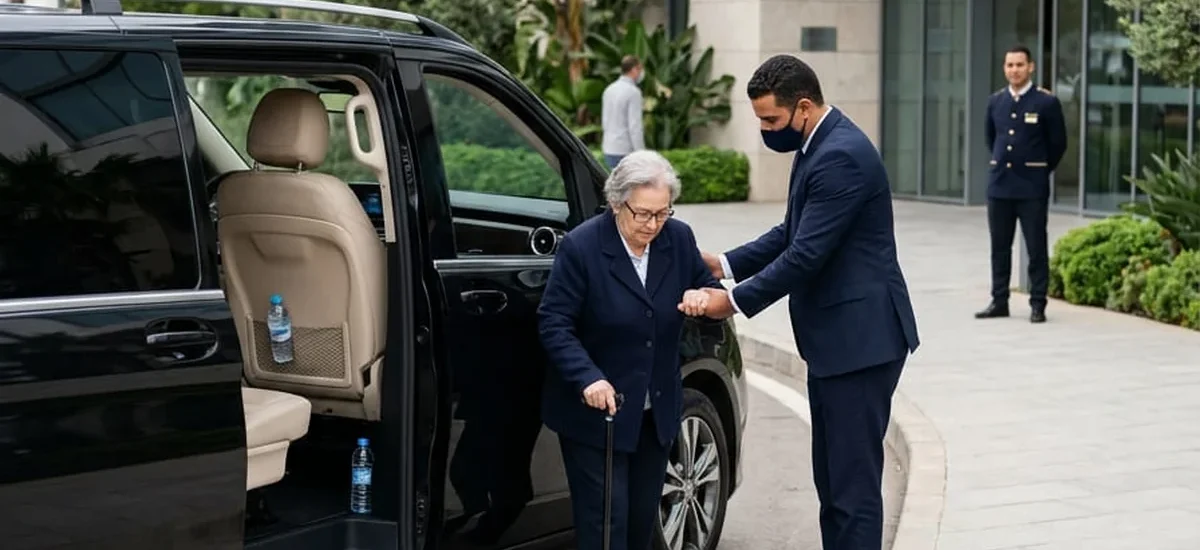
First, the chauffeur brings the vehicle as close as possible to the kerb on the passenger side, then locks the doors while the patient gets in. A firm hand at the arm, a stable support, and the manoeuvre takes a few seconds. Position counts more than engine power. A slightly reclined backrest eases the spine. A cushion slipped under the thighs limits pressure points, and a well-adjusted seat belt protects without pressing. The patient settles on the rear door side when legroom allows, with the companion beside him or her.
Luggage is loaded last, once the patient is seated. A folding wheelchair or a pair of crutches then fits in the boot of a minivan. It is enough to have mentioned it at booking. Boot volume also enters the safe seated transport equation, on the same level as legroom. Rather than aim for a boot that is too tight, a larger vehicle is the better choice, because the space available decides real comfort throughout the journey.
File, admissions and a check-list before departure
Administrative formalities take time and energy. Preparing them in advance lightens the arrival. This list covers the documents facilities ask for most often, without replacing the instructions of the admissions service.
- A passport in force and, where required, a visa or residence permit.
- An admission letter or appointment confirmation issued by the facility.
- Medical file, operation reports, test results and scans on a USB key.
- Current prescriptions and a list of treatments, with doses.
- Contact details of the referring doctor in the country of origin.
- Insurance documents, cover agreement or payment guarantee.
- Payment methods accepted by the facility, to be confirmed on site.
- Clothes that are easy to put on, shoes without laces, a phone charger.
In safe seated transport, the file travels with the patient.
Plan for the companion as well. Two adults handle the suitcases, the documents and the trips between reception and the vehicle better. One stays with the patient while the other moves the admission formalities forward. When the patient travels alone, say so when booking the transport. The chauffeur will then allow the time needed for getting in, getting out and handing the luggage to the reception service.
Booking seated transport with Booking Taxi Maroc
Booking Taxi Maroc runs a fleet of Mercedes-Benz Vito and V-Class minivans and executive saloons. These vehicles offer the space needed for comfortable seating and for carrying luggage. The chauffeur adopts smooth driving suited to a passenger in convalescence. The company covers transfers from Mohammed V airport, Rabat-Salé airport and Rabat railway stations. It also offers a private chauffeur at your disposal for days of tests, consultations or visits. Intercity transfers complete the offer.
Three pages of the site set out these services: the trips and transfers on offer, the private chauffeur service at your disposal and the vehicle gallery.
For a request, the booking form is enough in most cases. Give the flight, the time, the number of passengers, the destination facility and the patient’s particular constraints. The team then replies with a suitable proposal, which the patient is free to accept or not.
The form is here: book safe seated transport with Booking Taxi Maroc. For an urgent question, the phone number +212 662 48 65 07 and the address Contact@bookingtaximaroc.com remain available.
Frequently asked questions about transfers to Rabat hospitals
How do I book a comfortable transfer from Mohammed V airport to the Cheikh Zaid hospital?
Send the flight number, the date, the landing time and the exact destination address. The provider then confirms the vehicle and the meeting point in the arrivals hall. A request sent a few days before departure leaves time to adjust the details.
Can the chauffeur help a patient who walks with difficulty?
Yes, assistance getting in and out of the vehicle is part of the service. The chauffeur carries the luggage and walks with the patient to the entrance lobby. He does not act on the medical side and gives no care.
Is a wheelchair needed for this kind of journey?
Not systematically. A patient able to stay seated for the journey travels without particular equipment. If a folding wheelchair or crutches travel with the patient, mention it at booking. The vehicle chosen will then offer the boot volume required.
How long should I allow between landing and arrival at the clinic?
Allow for luggage collection and the formalities, then the motorway journey to Rabat. The margin depends on traffic and on peak hours. A chauffeur who tracks the flight in real time adjusts his arrival accordingly.
Is safe seated transport suitable for a patient coming out of major surgery?
The answer belongs to the medical team following the patient. When monitoring during the journey is necessary, medical transport is required. Seated transport is for stable patients who can stay seated without particular supervision. Safe seated transport does assume a patient who is self-reliant during the journey.
Sources: Fondation Cheikh Zaid for information about the Cheikh Zaid International Hospital. Moroccan National Tourist Office for the context of a stay in Morocco.
This guide describes practical organisation, not a care protocol. The legal, tax and administrative points mentioned here are worth confirming with your own adviser. A lawyer, an accountant or any qualified professional can answer you, together with the care facility concerned.