Guide to MICE logistics in Morocco: succeeding with shuttle dispatching and group airport welcome at international summits
An international summit in Rabat is prepared for months on the scientific side. MICE logistics in Morocco, for its part, is decided in the final weeks, when registrations finally settle.
Speakers have already booked their flights. Delegations confirm their attendance in groups. Hotels are spread between Agdal, Hay Riad, Souissi and the medina.
Mohammed V airport remains the gateway for long-haul flights.
Several aircraft can land within the same time window, each carrying a share of the expected delegates. Without a method, the queue grows at the welcome point, vehicles leave half empty and the first bilateral meeting starts late.
This guide describes the mechanics of group transport from the provider’s side. It covers reading the arrivals schedule, building shuttle waves and named welcome. It also details flight status monitoring and the obligations that frame a dedicated fleet. It is aimed at congress organisers, event agencies and professional associations. These teams often answer a tender without an in-house transport department.
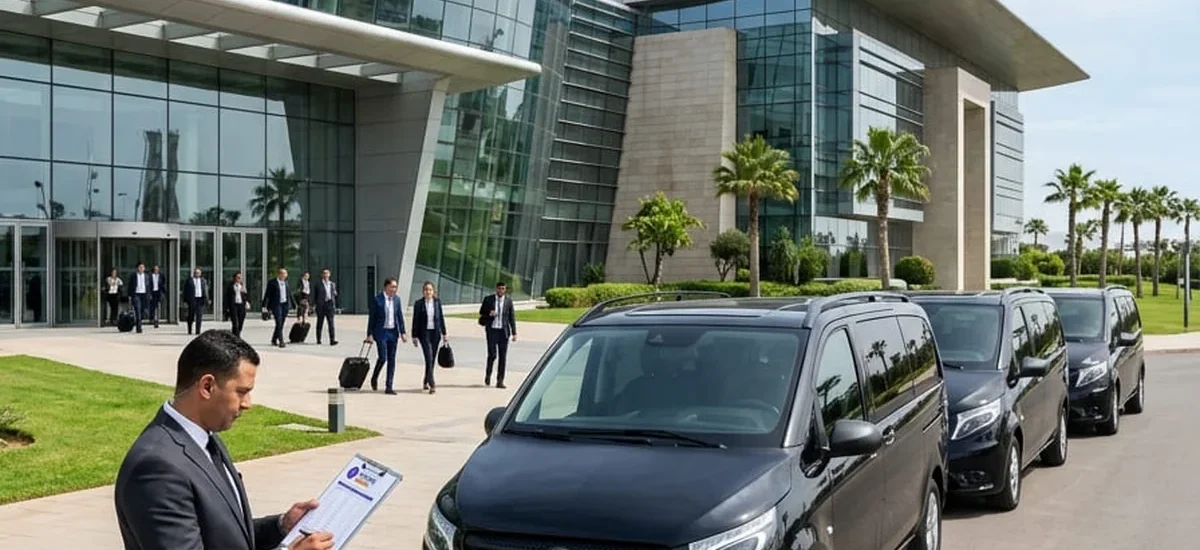
Booking Taxi Maroc (BTM) operates Mercedes-Benz Vito and V-Class minivans as well as executive saloons from Rabat. The company centralises the dispatching of its fleet for group arrivals and coordinates named welcome with dedicated event signage.
To move 200 VIP delegates from Mohammed V airport to the hotels of Rabat, dispatching rests on four steps. The organiser sends the flight list with the number of passengers and the destination hotels. The provider turns this schedule into time waves and assigns each wave the matching number of minivans. In the arrivals hall, an agent with a named list welcomes the delegates under signage bearing the event’s identity. He then directs them to the shuttle for their wave. A coordinator follows flight statuses continuously and reassigns the available vehicles. Every participant knows their meeting point, and the organisation has a single logistics contact throughout the welcome.
What MICE logistics in Morocco changes compared with an individual transfer
A classic private transfer links one passenger to one address, with a known flight and a single drop-off point. A congress works the other way round.
Participants fall into distinct categories: speakers, official delegations, exhibitors, organising staff, accompanying persons. Their flights differ, and so do their hotels. This heterogeneity shifts the workload. It is no longer measured in number of journeys, but in number of simultaneous decisions. A delayed flight moves an assignment. A participant who changes hotel modifies a route. The organisation’s spreadsheet stops being reliable as soon as arrivals run into hundreds of people.
MICE logistics in Morocco adds a distance constraint.
Mohammed V airport lies in the Greater Casablanca region, while most diplomatic and business summits are held in Rabat. The link uses the Rabat-Casablanca motorway. It calls for comfortable vehicles and planned rotations, without long waiting on site.
Event transport falls under the tender specifications. Budget, time commitments and possible penalty clauses are raised from the consultation stage. A group arrangement is contracted, it is not improvised on the morning of the opening.
Turning an arrivals schedule into shuttle waves
Everything starts with a simple file: flight number, expected landing time, number of passengers, destination hotel, protocol level. This file circulates badly, because three departments hold part of it: registration, protocol and hotel accommodation. Gathering it into a single table remains the first useful task.
Group flights by landing window
Arrivals are grouped by intervals rather than flight by flight. Two or three aircraft landing in the same window feed a single wave. The buffer covers immigration, baggage delivery and the exit from the hall. It is set on the real pace of the terminal at the hours concerned, not on a theoretical average.
Some arrivals stay out of the grouping. An isolated flight in the middle of the night is handled separately, with a vehicle mobilised at the exact landing time.
The same applies to a delegation travelling on a dedicated flight or a connection from a European hub.
Size each wave on the named list
The size of the wave determines the composition of the convoy, not the other way round. A homogeneous group of delegates heading to the same hotel fills a complete shuttle.
A wave spread across four establishments is split into several vehicles. The drop-off order limits U-turns in the ministerial district.
One last check before validation: every passenger on the list must appear in a wave and in a vehicle. Unassigned names point to a registration updated too late, a flight error or a duplicate.
Reserve dedicated vehicles for protocol speakers
Keynote speakers, session chairs and institutional representatives do not share a collective shuttle. These people often travel with a relative or a colleague. Their arrival conditions the next day’s programme. Their vehicle is named and waits for them at the exit of the hall.
Between two meetings, a private chauffeur service at your disposal keeps a vehicle on standby. The driver stays assigned, with no new arrangement to negotiate.
Building the shuttle dispatching on the day itself
On opening day, MICE logistics in Morocco is run as a table shared between three posts. A controller at the terminal, a coordinator on the hotel side, a liaison on the organisation side. Each post reads the same assignment status and reports its movements through the day. Labelling makes the system readable without explanation. Each wave carries a number, each vehicle displays the name of the hotel served and the number of the wave concerned. The welcome agent can thus direct a delegate who has just come out of the hall without checking his phone.
A shared table is worth more than a discussion group.
- A departures register records the actual time of exit from the terminal and the number of passengers on board.
- A hotel arrivals register confirms the drop-off, with the time and the number of rooms handed to the participant.
- A reserve vehicle stays available for the unexpected, without disrupting the following waves.
Coordination stops when the last delegate on the schedule has reached their hotel. The end of the day is rarely decided at the morning peak. It is decided on the delayed evening flight, when the teams are tired.
Centralised flight monitoring and delay management
Flight monitoring replaces intuition with shared information. The coordinator checks arrival statuses at regular intervals and reports any gap beyond the planned buffer. The organiser receives the information in the same channel as the protocol team, without having to ask for it.
Monitoring is prepared before the first landing.
A flight delay is not corrected by cancelling an assignment, but by moving it. The vehicle planned for the following wave leaves later. Another takes its place, or the wave is topped up with passengers from a flight that arrived early. This flexibility requires a fleet tracked in real time and a controller who knows the position of each driver.
Two situations deserve a written procedure in the specifications. The first concerns a very late landing, which shifts to the quieter hours of the terminal. The second concerns the arrival of a participant outside the planned slots, on a flight changed at the last minute. In both cases, the shuttle becomes a named taxi and the cost of the gap is negotiated in advance.
Named welcome and dedicated event signage
A delegate landing after a long-haul flight looks for simple information: where the person waiting for them is.
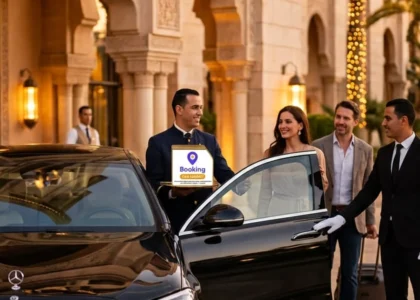
A visible panel bearing the name of the event is enough. The meeting point is set inside the hall, near the exit area. The welcome agent works with a named list and not with a flight list. He ticks off arrivals as they come and confirms the destination hotel. He then hands over three pieces of information: shuttle number, estimated departure time, duty number of the organisation.
One name, one hotel, one vehicle.
Signage is prepared upstream with the organiser. The visual identity of the event is carried over onto the panels. A backup set and a fallback point prevent confusion at peak hours. If the hall is crowded, the agent positions outside the area. That location is known to the drivers and announced to participants by email the day before.
The regulatory framework for road tourist transport
A fleet mobilised for a professional event falls within the scope of the Specifications for Road Tourist Transport (TTR) approved by the Ministry of Transport and Logistics. This text requires a van fleet under 5 years old and a strict six-monthly technical inspection. These two requirements weigh on the vehicle choice for a MICE convoy.
Asking for the documents before contracting is routine. An official delegation, a ministry or an international organisation checks the age of the vehicles and the validity of the inspections. A carrier whose compliance file is up to date answers within a few hours. One who rebuilds it in a hurry creates a risk for the organiser.
The general framework for business travel in the Kingdom appears on the official portal of the Kingdom of Morocco. To prepare a file, the list of vehicles with their registration numbers and the inspection certificates form the minimum basis.
Reserved event parking and access to the hotels of Rabat
The hosting capacity of a hotel says nothing about its drop-off capacity.
In front of some establishments, a single traffic lane allows a stop. That is enough for a car and blocks the street for a convoy of minivans. This constraint is settled upstream. The prefectural orders governing reserved event parking are the framework to mobilise in order to obtain dedicated spaces for the duration of the summit. The request is prepared with the organiser, the hotel and the carrier. Time slots, number of vehicles and locations concerned are set out in it. An authorisation obtained before the opening avoids improvised negotiations at the reception desk.
Two circulation principles limit friction. Shuttles rotate rather than park: a vehicle that drops off heads back to the airport or to the agreed waiting area. Drop-offs follow a coherent geographical order, from the furthest district to the nearest. This avoids crossing the same road twice at peak time.
For accompanying persons or participants who arrived early, a supervised outing often fills the quiet hours of the programme. The day trip from Rabat to Casablanca with a Hassan II Mosque ticket fits into a free half-day. The return is set before the evening plenary session. The full catalogue of private journeys appears on the excursions and transfers page.
Preparing the MICE tender and the event partner rate card
A transport tender is judged on the quality of the arrangement proposed, not only on an overall price. The forecast arrivals and departures schedule determines the precision of the answers received. Add the breakdown of participants by hotel and the protocol level expected by category.
Also attach the constraints of the event. Hotel access slots and session venues change the size of the convoys. An official security arrangement or the presence of accompanying persons also weighs on the calculation.
Four commitments are asked for explicitly in the specifications.
- A single logistics contact, reachable for the whole duration of the event.
- A rationalised transport plan, delivered before signature.
- A number of reserve vehicles.
- Documented TTR compliance for the entire fleet engaged.
MICE logistics in Morocco requires this level of detail from the consultation stage. The event partner rate card of BTM is not published online. It is built on the volume of waves, the spread of hotels, the time range and the reserve vehicles requested. It is sent with the transport plan, after review of the schedule provided.
Frequently asked questions about shuttle dispatching for congress delegates
How do you organise the transfer of 200 VIP delegates between Mohammed V airport and the hotels of Rabat?
Passengers are grouped by landing window. Each group gets a shuttle sized to its number and its hotel. A coordinator follows flight statuses and reassigns vehicles in the event of a delay. A named welcome in the hall avoids unnecessary waiting and half-empty departures.
Is it better to have one vehicle per hotel or a shuttle serving several establishments?
It depends on the spread. When several delegates in the same wave are heading to the same establishment, the dedicated shuttle remains the fastest solution. When the hotels are close, a combined convoy with two or three stops limits the number of vehicles mobilised.
What happens if a flight is delayed on the arrival day?
The coordinator receives the alert through flight monitoring and shifts the assignment concerned. The planned vehicle leaves at the new landing time. The following wave absorbs the passengers if capacity allows. A reserve vehicle covers the tightest cases.
Can you ask for a single contact for the whole duration of the event?
Yes, and this request normally appears in the specifications. The organisation then has a duty number for protocol, hotel reception and speakers. Particular cases go to the same contact.
Which documents should you ask the carrier for before signing?
First ask for the list of vehicles with their year of first registration. The inspection certificates and proof of compliance with the TTR specifications complete the file. An international organisation frequently adds an insurance certificate.
A summit is prepared better with a transport plan than with a shopping list. Send your arrivals and departures schedule through the MICE tender request form. You will receive a rationalised transport plan, the event partner rate card and the name of your single logistics contact on the day. Group welcome arrangements, framework contracts and dedicated fleets are handled on quotation, after review of the schedule. Phone: +212 662 48 65 07. Email: Contact@bookingtaximaroc.com.
Sources: Official portal of the Kingdom of Morocco · Moroccan National Tourist Office (Visit Morocco)