Luxury concierge service in Rabat: securing legal compliance and VIP standards for private excursions to Chefchaouen and Fès
A luxury concierge service in Rabat signs off on every journey it arranges for its guests. When a request for an immediate departure to Chefchaouen comes in at 9 pm, the head concierge has no time to audit an unknown provider. He needs a vehicle, a driver and a compliance guarantee, within the hour.
Guests in suites and private residences at a luxury concierge service in Rabat often ask the same question as they get into the car: “Can your driver also act as our guide?” That flattering sentence hides a delicate trade-off. The answer given on the spot commits the establishment’s liability and the reputation of the house for several seasons. A palace hotel that promises cultural accompaniment without checking the legal framework takes a risk nobody measures before the incident.
The sensitive point sits elsewhere: at the legal boundary between transport and cultural accompaniment, and in the way a desk respects it without ever slowing its guest down.
A private excursion to Chefchaouen mobilises two different trades. The loi n° 05-12 on the organisation of the tourism guide profession governs cultural accompaniment and draws the line between the licensed tourist carrier and the official guide-lecturer. The first carries passengers in a vehicle authorised and insured for that purpose; the second holds a professional card and comments on heritage. A licensed private driver therefore drives a group from Rabat to Chefchaouen without taking on the guide’s role. For the people on board, professional civil liability insurance standards determine the cover of the passengers carried. A day that promises transport and commentary requires two separate providers, and therefore two separate certificates.
Luxury concierge service in Rabat: keeping the promise of an immediate departure
The request rarely arrives at the right moment. A guest comes down to reception after dinner and announces that he is leaving for Chefchaouen at first light. Another wants a saloon car to catch a private flight brought forward by two hours. The desk has no margin, and no right to refuse either.
A seasoned operator absorbs that pressure without the hotel noticing. The Mercedes-Benz Vito and V-Class fleet, rounded out by executive saloons, covers a family of four as well as a delegation with luggage. Deployment happens in under 20 minutes for urgent needs departing from Rabat or Salé.
- Qualify the request: number of passengers, volume of luggage, desired return time, any mobility constraints.
- Hold the vehicle and name the driver before confirming anything to the guest.
- Send a written confirmation, with the pick-up time and the exact meeting point.
- Brief the driver on the expected standard, the names of the guests and the shape of the day.
That sequence takes a few minutes. It prevents the panicked call the next morning and the awkward conversation in front of a guest who discovers an anonymous vehicle parked under the porch.
The legal distinction between a licensed tourist carrier and a tourism guide
Moroccan law organises tourist accompaniment around separate trades. The loi n° 05-12 on the organisation of the tourism guide profession sets that division and sets the licensed tourist carrier against the official guide-lecturer. Understanding this separation helps the concierge answer the guest without improvising.
Every luxury concierge service in Rabat should be able to explain it.
What a licensed tourist carrier covers
The licence covers the movement of people for payment, in a vehicle assigned to that activity and covered accordingly. The operator commits to the safety of the journey, to compliance with driving times, to vehicle availability and to arrival at the destination. Its scope stops there. Historical commentary, leading a visit through the medina and interpreting heritage fall outside its licensing remit.
What the guide’s professional card authorises
A tourism guide practises a regulated profession, with a professional card issued by the competent authority. The job consists of accompanying a group and commenting on the monuments, the alleyways and the sites along the way. The guide walks with the visitors, structures the visit and answers questions. This profession does not authorise the guide to carry the group on behalf of a third party, and it does not replace the driver.
Why the confusion costs the establishment so much
A cultured and talkative driver will know how to explain why Chefchaouen is painted blue. On a journey of several hours, the temptation to present him as a guide is strong. The problem surfaces at the point of dispute, when a guest contests having paid for a cultural accompaniment service that was not delivered by an authorised professional. The concierge service then finds itself on the front line, with its own reputation at stake.
Civil liability insurance: the question to ask before entrusting a guest
For a luxury concierge service in Rabat, professional civil liability insurance standards for passengers carried form the second pillar of the check. A private excursion to Chefchaouen puts people on mountain roads for a whole day. Cover for the vehicle and cover for the people on board are two different things that a desk must be able to tell apart.
Good practice comes down to one written request: obtain the insurance certificate currently in force and check that it explicitly covers the transport of people. A serious provider hands over that document without argument. An evasive answer, an expired certificate or a document that does not mention passengers should be enough to rule the supplier out, even in the middle of high season.
A certificate is read, not assumed.
That check deserves repeating at every annual renewal. A certificate valid in January can lapse during the year. Nobody wants to discover that detail after an incident.
The check takes ten minutes. It prevents years of litigation.
Chefchaouen and Fès: two long days, two distinct arrangements
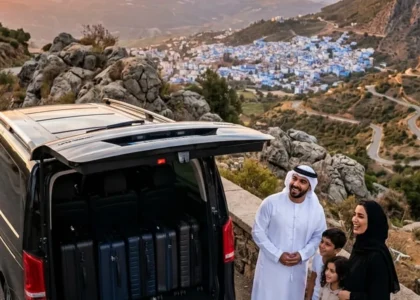
The two most requested excursions from Rabat are not run in the same way. Chefchaouen involves a mountain road in the Rif, an arrival in a compact medina and an evening return. Fès engages the motorway towards the spiritual capital, a dense day in a labyrinthine medina and a slower visiting pace. A luxury concierge service in Rabat prepares those days differently. The driver heading up to Chefchaouen must know the drop-off points close to the blue alleyways and anticipate the fatigue of the return. The one leaving for Fès must factor in long parking, breaks and coordination with the local guide. An oversight on these points turns into a complaint on the way back. The return from Chefchaouen often happens after sunset, when the mountain road demands more attention. From Fès, the fatigue built up in the medina weighs on the evening drive. The driver plans a break before the last stretch of road.
A tired group remembers the return.
Punctuality on the way back matters as much as punctuality on the way out.
On both destinations, the private chauffeur service at your disposal remains the most suitable arrangement. The vehicle stays with the group all day, the driver handles the stops, the luggage and the drop-off points. A guest free to set their own hours feels better served than with a string of rigid journeys. The private chauffeur service at your disposal answers exactly that expectation.
The concierge keeps an eye on two details. The first concerns coordination with an official guide, if the guest has asked for commentary in the medina. The second concerns the meeting point on the return, often neglected in dense cities. Two sentences in the written confirmation settle both.
24/7 WhatsApp responsiveness: a concierge service’s internal protocol
For a luxury concierge service in Rabat, round-the-clock availability does not mean answering anyhow. A desk that promises an immediate reply must rely on a single point of contact on the transport side, reachable at any hour. That is the role of the direct line reserved for hotel partnerships.
- A single number for the hotel, known to the head concierge and to the night watchman.
- A quick acknowledgement of receipt, even when the proposal is not ready yet.
- A vehicle committed before the firm answer to the guest.
- A written record of every request, to reconstruct the history in the event of a dispute.
This protocol protects both sides. The concierge does not commit to availability he does not control. The operator does not discover the request at departure time, when the fleet is already committed elsewhere.
One number is worth more than ten intermediaries.
The driver, a visible extension of the hospitality service
For a suite guest, the first human contact of the day rarely happens in the lobby. It happens in the back seat. The driver’s strict attire, punctuality and discretion extend the experience of the establishment well beyond the porch, all the way to the alleyways of Chefchaouen or the gates of Fès.
The driver’s silence is part of the service.
A few simple instructions are enough to hold that level. Phone on silent throughout the journey. Radio volume suited to the conversation of the passengers. Spontaneous help with luggage and with elderly guests. No comment on the private lives of the guests, no information shared once the day is over. Those details are noticed more than the make of the vehicle, and a luxury concierge service in Rabat is built on them.
Hotel partnership: business referral agreement and priority service
A luxury concierge service in Rabat that regularly steers its guests towards the same excursions gains from formalising the relationship. The business referral agreement clarifies the mutual commitments, the priority of handling in high season and the billing process. The concierge gains a named contact instead of one number among others.
The private day trip from Rabat to Chefchaouen and the day trip to Fès form the usual foundation of those partnerships. Airport and station transfers for group arrivals come on top.
Every agreement rests on real volume.
The conditions obtained are negotiated case by case, depending on volume and seasonality. No standard rate applies to this type of agreement: each file leads to a written proposal suited to the clientele of the house.
Checking a provider in ten minutes: the head concierge’s grid
The control grid of a luxury concierge service in Rabat fits on a single page. It is handed to the night watchman and filed in the provider’s folder. A quick check, applied to every new supplier, prevents most incidents.
- Tourist transport licence currently valid, with the name of the operator.
- Civil liability insurance certificate covering the passengers carried.
- Vehicle matching the stated capacity and properly maintained.
- Driver identified, reachable, introduced to the hotel before the first job.
- A single point of contact for urgent requests, including at night.
- The shape of the day confirmed in writing for long excursions.
This check also applies to regional partnerships, when a request concerns a distant city. Compliance is not delegated, not even to a trusted colleague.
An out-of-date insurance certificate protects nobody.
Frequent questions from head concierges
Can a licensed private driver comment on the monuments on the road to Chefchaouen?
He can answer practical questions and give general landmarks during the journey. Structured cultural accompaniment, on the other hand, falls to the tourism guide, whose profession is regulated. For a guided visit in the medina, a luxury concierge service in Rabat arranges two separate people: a licensed carrier and an official guide-lecturer.
Who covers a passenger injured during a private excursion?
The answer depends on the carrier’s insurance contract and on its compliance with professional civil liability insurance standards for passengers carried. A luxury concierge service in Rabat keeps the provider’s certificate in its supplier file. Where a particular situation is in doubt, the question goes to the provider’s insurer and to the legal adviser of the establishment.
How do you obtain a proposal for a hotel partner or a VIP request?
The request goes through the direct line reserved for concierge services and through the site form, with the date, the number of passengers and the type of vehicle expected. A written proposal then comes back, suited to the profile of the clientele and to the estimated volume. No automatic booking is offered for this type of service, which is handled on quotation.
Which excursions from Rabat fall within a hotel agreement?
The long days to Chefchaouen and Fès make up most of the demand, along with private chauffeur services at your disposal and transfers to airports and stations. The exact scope is set at the proposal stage, according to the needs of the establishment.
Is the service still available at night for an emergency?
The WhatsApp line reserved for hotel partnerships stays reachable 24/7, including for a very early departure or a flight brought forward. The protocol provides for a quick acknowledgement of receipt, then a firm answer once the vehicle is confirmed.
Opening a direct line with the hotel partnerships manager
A luxury concierge service in Rabat or in Salé receives guests who are demanding about private excursions to Chefchaouen and Fès. It can ask for a partnership proposal. The hotel partnerships department reviews every file, sets the preferential conditions and guarantees priority of handling in high season. The request is submitted through the site contact form, or directly by phone on +212 662 48 65 07 and by e-mail at Contact@bookingtaximaroc.com. A business referral agreement then frames the relationship, with a single point of contact on the transport side. The partnership file compiles the information needed for the review: estimated volumes, peak demand periods and vehicle preferences. The written answer sets the preferential conditions and the billing process. This framework avoids improvised discussions when a group arrival comes in.
Official sources consulted: Ministry of Tourism, Handicrafts and Social and Solidarity Economy and Moroccan National Tourist Office. The legal and insurance points raised in this article should be confirmed with your own adviser.