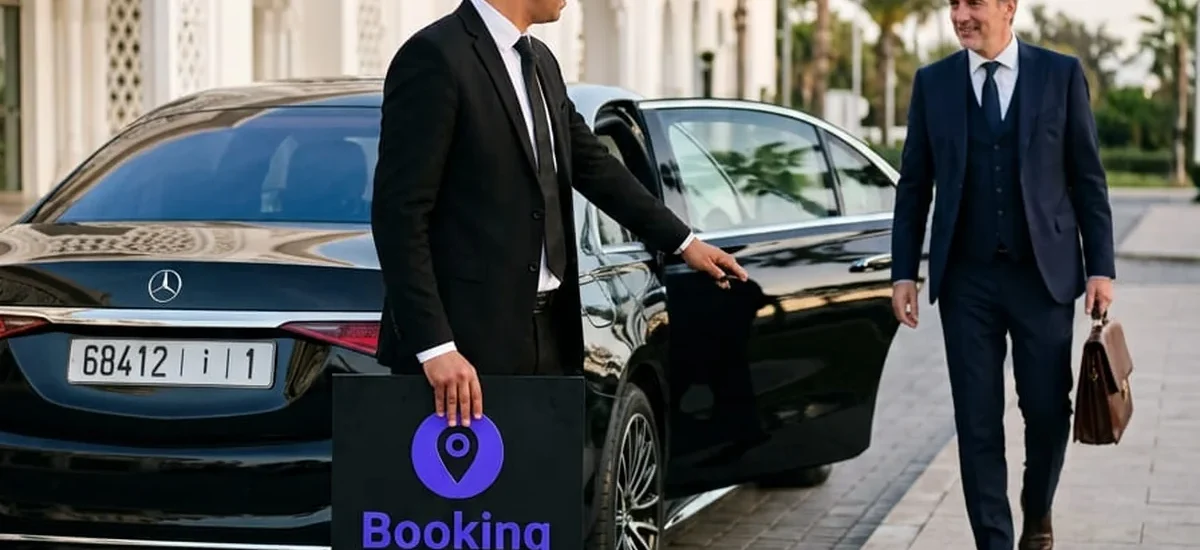
Diplomatic welcome in Rabat: security requirements, ministerial approvals and VIP logistics between Rabat-Salé airport and Souissi
An official delegation aircraft does not land like an ordinary flight. A diplomatic welcome in Rabat involves passenger lists, identified vehicles and briefed drivers. The mission officer carries that organisation from the tarmac to the residence gate.
State protocol accepts no improvisation.
Two bodies of law meet in this file. Moroccan law governs transport activity. International law on diplomatic relations adds obligations tied to the status of the people being received.
Souissi holds a large share of the embassies and diplomatic residences of the capital. The district is reached from the airport platform by a direct road route. Every step counts, from collecting official luggage to crossing the controlled perimeter. A disorganised arrival is noticed at once. This article sets out the applicable framework, the trade-offs protocol must make and the way to vet a provider. It sells nothing. It lists the points that are verified before entrusting protected people to a vehicle. An official visit is often judged on these organisational details.
What Moroccan law requires for a diplomatic welcome in Rabat
The Dahir n° 1-63-260 du 12 novembre 1963 relatif aux transports par véhicules automobiles sur route sets the framework for road transport activity in Morocco. A company that carries people against payment therefore operates in a regulated trade. Its obligations cover the vehicle, the driver and the documents carried on board. On a protocol journey these rules do not disappear. They become more visible, because the convoy draws attention. This legal framework applies to every journey, including a diplomatic welcome in Rabat.
The Décret n° 2-63-364 fixant les conditions d’agrément des transporteurs touristiques adds an entry condition. That text determines who may carry out tourist transport and on what terms. It also covers the classification of the vehicles assigned to that activity.
The consequence is concrete for the organiser. A copy of the provider’s agrément is requested before signing. It is then compared with the registrations of the vehicles that will actually turn up on the day of arrival. A protocol officer does not check compliance in place of the administration. He can, however, refuse to put a dignitary into a car whose status and insurance he does not know. That requirement is in no way offensive to a serious operator.
None of this belongs to luxury.
The security requirements of a diplomatic welcome in Rabat
Three areas are documented before the mission leaves. A diplomatic welcome in Rabat is judged on that preparation, even before the cars arrive.
Identified and vetted driver
The drivers’ names are sent in writing in advance. The licence number and a photograph accompany that list. On the day of the mission, the person at the wheel must match it. A last-minute replacement with no notification leaves the mission with no capacity to check at all. Identity is verified in front of the vehicle, at the moment of departure. Drivers trained for these missions apply the same principle: they do not comment on their passengers and publish nothing on social media.
Vehicle, equipment and visible condition
The car arrives washed, with a full tank and working air conditioning. Water on board and charging cables are part of the expected service. Tinted windows protect the confidentiality of exchanges. The boot takes hand luggage without stacking official briefcases on the floor. An executive saloon is enough for a principal and one accompanying person. A van becomes necessary as soon as the delegation includes several people or carries diplomatic material.
Traceability of movements
A mission log, kept by a single person, records the pick-up time, the registration, the driver’s name and the drop-off point. That document is used during the mission, for programme adjustments, and afterwards, to answer protocol questions.
The route between Rabat-Salé airport and the embassy district
The airport platform sits on the Salé side. Reaching Souissi means crossing the conurbation, then crossing the Bouregreg to enter Rabat. The journey ends in the residential districts of the capital’s south-west, where several foreign missions are located. The route is only the visible part of a diplomatic welcome in Rabat.
Two points decide whether the transfer succeeds. The first is pre-positioning: the cars wait before the announced landing, never after. The second is the phone chain. One number reachable on the mission side and one reachable on the provider side are tested before the vehicles leave. A schedule gap is then handled within minutes.
Both points are prepared the day before.
On a sensitive mission, two routes are scouted beforehand. The driver knows the main route and the fallback. He does not consult his phone while driving and does not improvise at the last traffic light. That preparation reduces time spent in traffic, the least controllable part of the journey.
Access to the airport perimeter and coordination with the authorities
Waiting areas outside a terminal are not run like a hotel car park. Vehicle access near the exit is a matter for the platform operator and the services on duty there. The mission prepares its formalities before arrival.
The Ministry of Foreign Affairs, African Cooperation and Moroccan Expatriates remains the institutional point of contact for representations accredited in Morocco. Questions of protocol, badges and the crossing of controlled points go through that channel on the mission side. The provider supplies the requested items: registrations, driver names, planned times.
An unannounced vehicle waits.
That wait then affects the visit programme, and the delay is rarely made up on the spot.
What the Vienna Convention changes for people and luggage
The Convention de Vienne sur les relations diplomatiques (art. 29 et 36) sets obligations for the receiving State. Article 29 requires the diplomatic agent to be treated with due respect. It also requires appropriate measures to prevent any attack on his person, his freedom and his dignity. Article 36 deals with the customs exemption granted to objects intended for the official use of the mission and to the personal effects of the agent.
That nuance deserves to be stated without detour.
These provisions are addressed to the State and to diplomatic agents. The driver of a private provider does not benefit from them. He remains subject to Moroccan law and to ordinary checks, even when he drives a protected dignitary. That misunderstanding creates needless tension around the airport. On a diplomatic welcome in Rabat, these articles have a practical translation. Official luggage arriving with the delegation can travel in a vehicle separate from the one carrying people. That separation lightens the lead car and eases formalities. It also avoids blocking an exit during unloading. The provider counts the pieces without opening the contents.
The logistics detail matters as much as the law.
Saloon, van or unmarked vehicle: deciding according to the mission
The choice depends on the doctrine of the representation that receives the delegation.
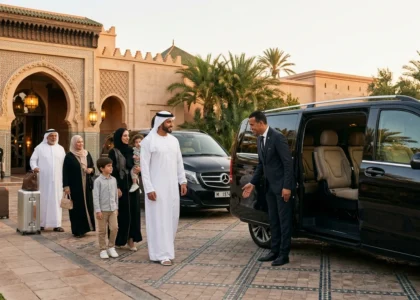
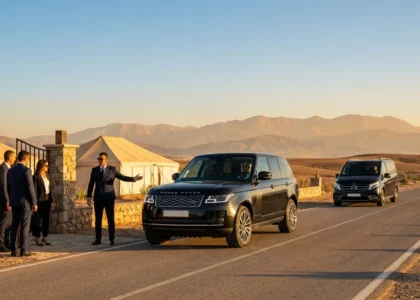
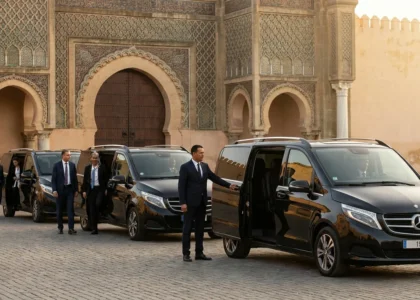
An unmarked van or black saloon lets the delegation slip through ordinary traffic discreetly. A vehicle identified with the mission name makes the convoy visible, with a downside: everyone knows who is travelling and where. The most frequent request remains unmarked black. Fleet matters as much as discretion. Mercedes-Benz Vito and V-Class minivans and executive saloons cover both uses. Their usable volume exceeds that of a courtesy car, which counts as soon as the delegation travels with luggage.
The context of the visit decides.
The size of the motorcade is settled at the end, once the passenger list is stable. Too many cars clog the kerbside in front of the terminal. Too few force a rotation, and the movement loses its simultaneity.
A motorcade is not filled out of habit.
Drivers, discretion and confidentiality of exchanges
A driver assigned to a diplomatic mission hears conversations that do not concern him. His training covers silence, smooth driving and handling the unexpected without drama.
Silence is part of the service.
He does not brief a third party met at a reception about his passengers. He does not mention a route out loud in front of the rear seat. That restraint applies to writing too, since a journey is not commented on in a messaging group. The convoy is driven as a group. Distances are held, evasive manoeuvres are limited, and hazard lights are reserved for a real stop. The leading driver follows the plan, the one at the rear watches the convoy close up. A convoy that breaks apart in traffic attracts the attention it is trying to avoid.
Punctuality is prepared before departure.
The protocol officer’s trade-offs, phase by phase
Before the mission, the work consists in locking down a scenario. Framing a diplomatic welcome in Rabat includes the number of people, the volume of luggage, the successive destinations and the arrival times. It also names the person who will approve changes during the day. Access constraints at the airport perimeter are dealt with at the same time. One contact on the delegation side, one on the provider side: the chain stays short and decisions are taken fast. Execution comes next. During the mission, three actions are enough. Confirm the pick-up at departure. Report any schedule gap without delay. Keep the mission log up to date.
Nothing else is decided on the road.
Any initiative outside the plan is approved by the protocol officer, including the addition of an unscheduled stop. After the movement, the debrief happens while it is fresh: a delegation that comes back genuinely tests the quality of a provider.
What to ask a provider before signing
A diplomatic welcome in Rabat is rarely entrusted to chance. The checklist below is used to vet a carrier before signing.
- A valid agrément and the insurance documents of the vehicle assigned, with the exact registration.
- A named list of drivers, licences and identity documents, sent before the mission.
- Procedure in the event of vehicle failure and the time needed to bring a replacement.
- Direct contact details of the service manager, reachable throughout the mission.
- Confidentiality rules accepted in writing and how passenger data is handled.
- Invoicing arrangements and the contractual framework for repeated missions.
These requirements are a matter of administrative common sense. They avoid discovering on the day that a replacement vehicle is not covered or that no manager can be reached.
None of these points is negotiated lightly.
Requesting a dedicated chauffeur service proposal
Booking Taxi Maroc runs this type of mission with experienced drivers trained for discretion requirements, and immaculate Mercedes-Benz vans, executive saloons included. The service is quoted on a custom basis. The number of vehicles, the duration of the disposition and the reception plan are calculated from the delegation’s actual itinerary, never from a standard package. Invoicing separates the disposition from any additional hours.
The protocol quote remains custom.
The protocol officer can submit the delegation’s programme, flight times, drop-off points and the number of passengers. A dedicated chauffeur service proposal comes back within 2 hours, with the vehicles, the drivers and the organisational arrangements. For a recurring arrangement, a corporate agreement opens an annual contractual framework, discussed mission by mission.
The brand is rated 5,0 on Google, based on 16 reviews. Direct contact: +212 662 48 65 07 and Contact@bookingtaximaroc.com. The fleet and the interior fittings can be seen in the gallery. The service with a driver is detailed on the private chauffeur service page. All transfers and excursions appear on the trips page.
Frequently asked questions about transporting a delegation in Rabat
Is a specific agrément required to transport a foreign delegation in Morocco?
Carrying people against payment falls under the Dahir n° 1-63-260 du 12 novembre 1963 relatif aux transports par véhicules automobiles sur route. Tourist activity requires the agrément provided for by the Décret n° 2-63-364 fixant les conditions d’agrément des transporteurs touristiques. Ask for a copy of that agrément and compare it with the vehicles announced.
Is an unmarked black vehicle compulsory for a diplomatic mission in Souissi?
No text imposes a colour or the absence of insignia. Practice favours the unmarked vehicle for confidentiality, and the choice belongs to the representation that receives the delegation. A black saloon or van remains the most common request.
What does the Vienna Convention provide for diplomatic luggage?
Article 36 of the Convention de Vienne sur les relations diplomatiques governs the customs exemption for objects intended for the official use of the mission and for the personal effects of the agent. Between the airport and Souissi, official luggage can follow in a separate vehicle. That arrangement simplifies formalities on leaving the terminal.
Who is answerable for a delay during the transfer between Rabat-Salé airport and the embassies?
Responsibility is allocated in the quote and the agreement. State in writing who handles waiting at the terminal, who approves a change of time and who bears the cost of an extended disposition.
When should preparation for a diplomatic welcome in Rabat start?
A diplomatic welcome in Rabat is prepared as soon as the visit programme is known. Administrative checks, driver lists and airport perimeter access procedures take time. These steps cannot be compressed the day before arrival.
For a diplomatic welcome in Rabat, the dedicated request form remains the entry point: submit the delegation programme. A costed protocol proposal comes back within 2 hours, with the vehicles, the drivers and the reception plan. The phone +212 662 48 65 07 stays open for urgent framing, and the address Contact@bookingtaximaroc.com for sending official documents.
Sources consulted: Convention de Vienne sur les relations diplomatiques, texte français (Nations Unies) and Ministry of Foreign Affairs, African Cooperation and Moroccan Expatriates.